Miami Heat and the True Cost of a Broken AC
No city in the continental United States puts more daily pressure on a residential air conditioning system than Miami. Temperatures regularly push into the upper 90s from May through October, humidity hovers above 70 percent for months at a stretch, and salt air from Biscayne Bay and the Atlantic works its way into outdoor condenser coils even miles from the shoreline. The result is a city where AC repair Miami services are not a seasonal luxury. They are a year-round necessity.
When a system fails in this environment, the first question every homeowner asks is a practical one: how much is this going to cost? According to industry experts like United State Solutions, AC repair Miami costs can vary significantly depending on the type of system, the severity of the problem, the parts required, and whether the call comes in during regular hours or as an emergency dispatch in the middle of a July night.
This guide provides a complete 2026 pricing breakdown for AC repair in Miami. It covers everything from minor thermostat fixes to full compressor replacements, explains why South Florida repair costs run higher than national averages, and helps homeowners understand when a repair makes financial sense versus when a full system replacement is the smarter investment.
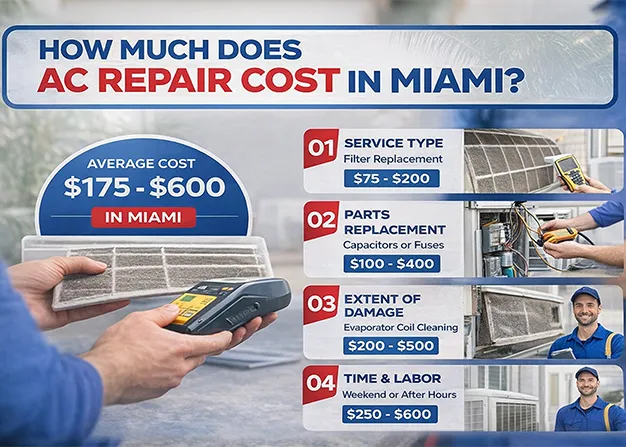
Quick Answer: Average AC Repair Cost in Miami in 2026
AC repair in Miami typically costs between $150 and $850 for most standard service calls. Minor fixes sit at the lower end of that range, while major component repairs push toward or beyond the upper limit. Emergency service calls carry an additional surcharge on top of the base repair cost.
2026 Miami AC Repair Cost at a Glance:
- Minor repairs (thermostat, filters, fuses): $100 to $350
- Moderate repairs (refrigerant recharge, electrical): $350 to $900
- Major repairs (compressor, evaporator coil): $900 to $2,500 or more
- Emergency / after-hours surcharge: $100 to $300 added to base repair cost
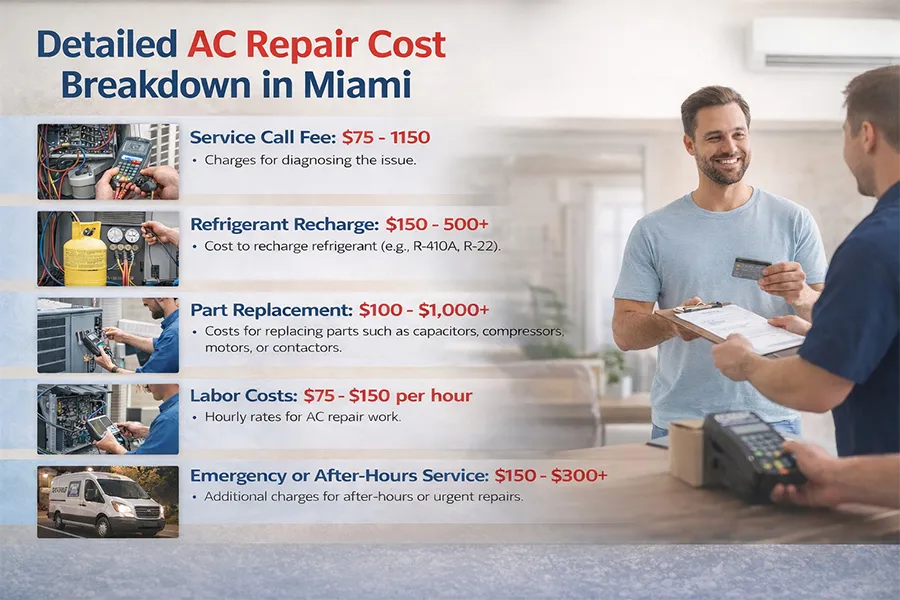
- Diagnostic / service call fee: $75 to $150 (often credited toward repair)
These ranges reflect verified 2026 pricing data from licensed HVAC providers operating across Miami-Dade County. The actual cost of any specific repair depends on the system type, the age of the unit, the parts required, and the contractor chosen.
Quick Pricing Reference Table:
| Repair Category | Low End | High End | Typical Cause |
| Minor Repairs | $100 | $350 | Thermostat, filters, fuses |
| Moderate Repairs | $350 | $900 | Refrigerant recharge, electrical |
| Major Repairs | $900 | $2,500+ | Compressor, coil replacement |
| Emergency Surcharge | +$100 | +$300 | After-hours / holiday dispatch |
| Diagnostic / Service Call | $75 | $150 | Often credited toward repair |
Detailed AC Repair Cost Breakdown in Miami
The wide pricing range for AC repair in Miami reflects the wide variety of problems that can affect a cooling system. Breaking costs down by repair category helps homeowners calibrate their expectations before the technician arrives.
Minor AC Repairs: $100 to $350
Minor repairs cover the issues that are relatively straightforward to diagnose and inexpensive to fix. Thermostat problems are among the most common. When a thermostat fails to register the correct temperature, runs continuously, or stops responding, the repair typically runs between $100 and $300 depending on whether the unit needs recalibration or full replacement. Smart thermostat installations land at the higher end of this range due to the added configuration time.
Air filter replacement is one of the few HVAC tasks Miami homeowners can handle themselves for $15 to $80 in parts cost. However, an improperly installed or wrong-size filter can cause downstream airflow problems that are more expensive to address. Having a technician verify filter fit during a routine visit is worthwhile. Condensate drain line clearing, at $75 to $250, falls into the minor category and is one of the most frequent service calls in Miami due to the city’s relentless humidity and algae growth in drain lines.
Capacitor replacement costs between $180 and $350 and consistently ranks as the single most common repair in Miami’s climate. A capacitor is the small component responsible for starting and running the compressor and fan motors. Florida’s heat causes them to fail far more frequently than in cooler regions. If a system hums but fails to start, a blown capacitor is often the culprit. Contactor replacement runs a similar range of $170 to $320, with coastal salt air accelerating wear on these electrical switching components.
Moderate AC Repairs: $350 to $900
Moderate repairs involve either more complex parts or more diagnostic time than a simple component swap. Refrigerant handling sits at the center of this category. Recharging an R-410A system costs $150 to $400 per pound of refrigerant added. But a critical point for Miami homeowners to understand is that a system losing refrigerant has a leak somewhere. A reputable technician will locate and repair the leak alongside the recharge. Refrigerant leak repair ranges from $350 to $1,800 depending on where the leak is, how accessible it is, and how much component work the seal requires.
Electrical wiring repairs cover a broad set of problems, from tripped breakers and blown fuses to deteriorated wiring in the air handler. These repairs run $200 to $600 and require a licensed technician. In Miami-Dade County, electrical work on HVAC systems must comply with local building codes, which affects both the scope of allowable repairs and the associated labor costs. Blower motor repair or replacement is another moderate-category repair, running $450 to $900. Variable-speed motors, found in more modern high-efficiency systems, cost more to replace than standard single-speed motors due to both parts cost and the calibration required after installation.
Major AC Repairs: $900 to $2,500 and Above
Major repairs are the calls that prompt a genuine conversation about whether to fix the existing system or replace it entirely. Evaporator coil replacement runs $1,100 to $2,600 in Miami. The evaporator coil sits inside the air handler and facilitates heat exchange. In coastal Miami, corrosion from humidity and salt air attacks coil surfaces faster than in inland markets, making this a more frequent major repair for beachside and bay-front properties. Dirty coils are also a leading cause of frozen systems, and cleaning costs $100 to $400 when caught early enough to avoid replacement.
Compressor replacement is the largest single repair on most residential AC systems, ranging from $1,400 to $3,200 in Miami. The compressor is the mechanical heart of the cooling system, and when it fails, the entire system stops functioning. For systems under warranty, the compressor part cost may be covered, though labor and refrigerant handling are typically not. For out-of-warranty systems over 10 years old, a failed compressor frequently tips the financial calculation toward full system replacement rather than repair.
Full Component-Level Pricing for Miami AC Repair (2026):
| Repair Type | Low | High | Notes |
| Thermostat replacement | $100 | $300 | Smart thermostat installs cost more |
| Air filter replacement | $15 | $80 | Basic DIY to pro-grade filter |
| Drain line clearing | $75 | $250 | Common Miami humidity issue |
| Capacitor replacement | $180 | $350 | Most frequent Miami repair |
| Contactor replacement | $170 | $320 | Wears fast in salt air |
| Refrigerant recharge (R-410A) | $150 | $400 | Per pound + leak detection |
| Refrigerant leak repair | $350 | $1,800 | Cost varies by leak location |
| Electrical wiring repair | $200 | $600 | Breaker, fuse, wiring issues |
| Blower motor repair/replace | $450 | $900 | Higher for variable-speed motors |
| Evaporator coil replacement | $1,100 | $2,600 | Corrosion common in coastal Miami |
| Compressor replacement | $1,400 | $3,200 | Most expensive single repair |
| Full system replacement | $4,500 | $12,000+ | Size, efficiency, brand dependent |
What Factors Affect AC Repair Costs in Miami?
No two AC repairs in Miami carry the same price tag, even for the same type of problem. Several variables interact to produce the final cost on any given service call.
Type of AC System
Central air conditioning systems are the most common configuration in Miami-area homes and represent the baseline for most pricing discussions. Split systems, which use a separate outdoor condenser and indoor air handler, are the most frequent residential setup and what most technicians encounter. Ductless mini-splits are increasingly common in older Miami homes without existing ductwork and in newer energy-efficient builds. Repairs on mini-splits often cost more than on traditional central systems due to the advanced electronics involved and the specialized tools required for refrigerant handling on these units. Package units, which house all components in a single outdoor cabinet, present their own access and parts-sourcing considerations.
Severity of the Issue
The difference between a $150 repair and a $2,500 repair often comes down entirely to which component has failed. A capacitor swap is a quick, inexpensive parts-and-labor job. A compressor replacement involves refrigerant recovery, heavy component removal, installation of a new unit, system recharge, and performance testing, all of which adds up in both time and cost. The diagnostic step is where a skilled technician distinguishes between these scenarios. Misdiagnosing a moderate issue as a major one, or vice versa, creates real financial consequences for homeowners. Getting a written estimate with specific parts and labor listed before approving any work is the single most important step in the repair process.
Labor Costs in Miami
Labor rates in Miami run higher than in smaller Florida markets. HVAC technicians in Miami-Dade typically charge $75 to $150 per hour, with the higher end reflecting licensed, insured contractors working on complex systems. Labor accounts for roughly 50 percent of the total cost on most standard repairs. Miami’s higher cost of living, stricter licensing enforcement, and the insurance requirements for working in hurricane-risk zones all contribute to labor costs that sit above national averages. That premium is worthwhile. Unlicensed contractors may quote less, but they carry no accountability if the repair fails or causes damage, and their work can void manufacturer warranties on the equipment.
Emergency vs Scheduled Repair
The timing of a repair call has a direct effect on what it costs. A scheduled visit during regular business hours is priced at the standard rate. A same-day call during summer peak demand carries a higher priority dispatch fee in most cases. A call at 11:00 PM on a Saturday during a heat wave adds an after-hours emergency surcharge of $100 to $300 on top of the base repair cost. For homeowners who can tolerate the discomfort for a few hours, waiting until the next morning for a scheduled visit can meaningfully reduce the total bill. For those with health conditions that make extreme heat dangerous, the emergency premium is money well spent.
Why AC Repair Costs Are Higher in Miami Than the National Average
Miami homeowners who have lived in other parts of the country often notice that HVAC service costs more here. That observation is accurate, and there are specific, legitimate reasons behind it.
The most fundamental factor is usage. Florida AC systems run 10 to 12 months per year, compared to four to six months in northern states. Miami systems often operate 12 to 16 hours per day during summer. That near-continuous operation puts every component under load that simply does not exist in seasonal climates. Capacitors, contactors, motors, and refrigerant seals all wear faster. The result is more frequent repairs and higher per-repair costs due to the accelerated condition of aged components.
Miami’s coastal humidity adds a second layer of demand on top of the temperature load. The system must remove moisture from the air in addition to lowering the temperature, which increases compressor runtime and accelerates coil degradation. Condensate drain lines clog more frequently from algae growth fueled by the moisture. Mold can develop inside air handlers when the system is not functioning properly, adding remediation costs to what might otherwise be a straightforward repair.
Salt air is the third Miami-specific factor. Properties within several miles of Biscayne Bay, the Atlantic coast, or the various Miami Beach barrier islands are exposed to airborne salt particles that accelerate corrosion on condenser coils, electrical terminals, and copper refrigerant lines. Outdoor components that might last 15 years in an inland market can show significant corrosion in 8 to 10 years in coastal Miami. Specialized corrosion-resistant coatings and replacement parts cost more than standard components, and that difference flows through to the repair invoice.
The 2026 refrigerant transition is also pushing costs upward this year. The industry is moving from R-410A to R-454B (Puron Advance). During this transition period, contractors must stock both refrigerant types, maintain dual-rated recovery equipment, and ensure technicians are trained on the new handling requirements. Those operational costs are reflected in current service pricing across Miami-Dade County.
Common AC Problems That Drive Repair Costs in Miami
Certain failure types appear consistently across Miami homes, driven by the same climate factors that make HVAC work more expensive here than in other markets.
AC Not Cooling: What It Costs to Fix
When an AC system runs but fails to bring the indoor temperature down, the cause is typically one of three problems: low refrigerant, a failing compressor, or a dirty evaporator coil restricting heat transfer. The cost to address this depends entirely on which of these is the actual culprit. A refrigerant recharge costs $150 to $400 plus leak detection and repair if needed. A coil cleaning runs $100 to $400. A compressor replacement starts at $1,400. The diagnostic step, which should precede any repair authorization, is what determines which of these is the real issue.
Refrigerant Leaks: Cost and Consequences
A properly sealed AC system circulates refrigerant in a closed loop and should never need to be refilled under normal operating conditions. When a system repeatedly loses refrigerant, there is a leak. In Miami’s climate, refrigerant lines and coil connections are under stress from heat cycling and corrosion. Repair costs range from $350 for a minor, accessible leak to $1,800 for a leak in a difficult-to-reach location requiring significant disassembly. The cost of refrigerant itself also factors in. R-410A runs $50 to $80 per pound installed, while the increasingly scarce R-22 (used in pre-2010 systems) runs $90 to $150 or more per pound due to the phase-out.
Frozen Coils: Cause and Repair Cost
A frozen evaporator coil is a symptom rather than a root cause. The coil freezes when it drops below 32 degrees Fahrenheit, which happens when either airflow is restricted (dirty filter, blocked vent) or refrigerant is too low. Running a frozen system worsens the problem and risks compressor damage. The correct response is to shut the system off, let it thaw, and have a technician identify the cause. If the freeze resulted from a dirty filter, the fix is minimal. If it resulted from refrigerant loss, the cost moves into the moderate range. If the compressor was damaged by running frozen, the cost escalates into major repair territory.
Compressor Failure: The Big One
Compressor failure is the repair that most frequently triggers a replacement decision rather than a fix-it decision. At $1,400 to $3,200 for replacement, a compressor job on an older, out-of-warranty system often costs more than a meaningful fraction of what a new system would cost. The HVAC industry’s rule of thumb is the $5,000 rule: multiply the system’s age in years by the estimated repair cost. If the result exceeds $5,000, replacement is generally the smarter investment. A 12-year-old system with a $600 repair passes that test. The same system with a $1,800 compressor job does not.
AC Repair vs Replacement Cost in Miami: How to Decide
The repair-versus-replace question does not have a universal answer. It depends on the age of the system, the cost of the repair, the energy efficiency of the existing unit, and the homeowner’s plans for the property.
As a general starting point, if a system is under 10 years old and the repair cost is less than 50 percent of a replacement quote, repair is almost always the right call. If the system is over 12 to 15 years old and is facing its first major repair, the calculation becomes more nuanced. A new high-efficiency system in Miami can save $600 to $1,200 per year on energy bills compared to an aging unit that has been struggling for several seasons. At that savings rate, the payback period on a replacement becomes worth calculating.
The refrigerant type is another telling signal. Systems still running on R-22 refrigerant, which was phased out in 2020, face increasingly expensive repair costs as R-22 becomes scarcer. Replacing an R-22 system with a modern R-410A or R-454B unit eliminates that ongoing cost and improves energy efficiency at the same time.
Repair vs Replace Decision Guide:
| Situation | Repair (Recommended) | Replace (Recommended) |
| System age | Under 10 years old | 10+ years old |
| Repair cost vs system value | Repair is under 50% of replacement cost | Repair exceeds 50% of replacement cost |
| Refrigerant type | System uses R-410A or R-454B | System still uses R-22 (phased out 2020) |
| Energy bills | Bills are stable or declining | Bills rising despite repairs |
| Repair history | First or second major repair | Multiple major repairs in 3 years |
| Efficiency rating | System meets current SEER2 standards | System is below current efficiency minimums |
How to Save Money on AC Repair in Miami
The most reliable way to reduce AC repair costs in Miami is to prevent the most expensive failures from occurring in the first place. That is not a vague suggestion. It has a specific financial backing.
An annual AC maintenance tune-up in Miami costs $99 to $499 depending on what is included. A comprehensive tune-up covers coil cleaning, drain line flushing, refrigerant pressure checks, electrical component testing, thermostat calibration, and blower motor inspection. These are exactly the checks that catch a $12 capacitor problem before it becomes a $250 emergency replacement, or a slow refrigerant loss before it causes a $1,500 compressor failure. An AC system without regular maintenance loses approximately 50 percent of its cooling capacity within the first year of neglect in Miami’s climate.
Scheduling service in the spring rather than waiting for summer is both cheaper and more practical. Technicians across Miami-Dade County are significantly busier from June through August. Spring appointments are easier to schedule, carry standard rates, and allow any problems to be addressed before peak heat arrives. Homeowners who call for service in July are often competing with hundreds of emergency calls for the same technician availability.
Early diagnosis is the other major cost-saving behavior. When an AC system shows warning signs, including unusual sounds, reduced airflow, rising energy bills, or inconsistent cooling, calling for service immediately rather than waiting to see if the problem resolves itself almost always results in a smaller repair bill. Small problems in HVAC systems reliably become large ones if left unaddressed in Miami’s operating conditions.
- Schedule annual or semi-annual maintenance tune-ups: $99 to $499 vs potentially $1,500+ in avoidable major repairs
- Book service in spring before demand peaks and before emergency pricing kicks in
- Address warning signs immediately rather than waiting for a full system failure
- Ask about service contracts that include priority scheduling and discounted repair rates
- Verify that the diagnostic fee will be credited toward the repair before authorizing the service call
Emergency AC Repair Cost in Miami: What to Expect
Emergency AC repair in Miami is not the same as standard service pricing with a slight bump. After-hours, weekend, and holiday dispatches carry premiums that typically add $100 to $300 on top of the standard repair cost. For context, an emergency compressor diagnosis on a Saturday night might carry a $150 service call fee, a $150 after-hours surcharge, and then the actual repair cost on top of both. Understanding that structure before calling helps homeowners make informed decisions about whether to proceed immediately or wait until the next business day.
For most healthy adults, a few hours of discomfort is manageable. For households with elderly residents, infants, or individuals with respiratory or cardiovascular conditions, indoor temperatures above 85 to 90 degrees create genuine health risks. In those situations, the emergency premium is not a luxury. It is a medically justified expense.
The best mitigation strategy is preparation. Homeowners who schedule annual maintenance in spring, keep their systems in good condition, and address warning signs early rarely find themselves facing a weekend emergency call during a Miami heat wave. When the system is properly maintained, the chance of a sudden catastrophic failure drops significantly. When it does fail, a service contract that includes emergency coverage at no additional surcharge is one of the most practical investments a Miami homeowner can make.
How to Choose the Right AC Repair Company in Miami
The Miami-Dade HVAC market includes dozens of licensed contractors and a variable number of unlicensed operators who surface during peak demand. Choosing the right provider is not complicated, but it does require a few specific checks.
License verification is the first step. Florida law requires all HVAC repair work to be performed by a licensed contractor holding a CAC (Certified Air Conditioning Contractor) license. Homeowners can verify any contractor’s license status at myfloridalicense.com. Unlicensed repairs void equipment warranties, carry no consumer protection recourse, and expose homeowners to liability if an unlicensed technician is injured on the property. Local expertise also matters in Miami specifically, because the combination of hurricane-zone building codes, salt air exposure, and near-continuous system operation creates conditions that require technicians who understand South Florida’s specific demands rather than applying a generic repair approach.
Response time is a practical consideration, particularly during summer months. Companies that stock common parts on their service vehicles and maintain enough technician availability to offer same-day service in most cases provide meaningfully better outcomes than providers who diagnose on one visit and return with parts on a second. Every additional day without cooling in Miami’s heat is a genuine quality-of-life problem.
Warranty coverage is the third major differentiator. Standard industry warranties on AC repair labor run one to two years. Providers who offer significantly longer coverage, such as the 15-year parts and labor warranty offered by HVAC professionals like United State Solutions, change the long-term financial equation for homeowners. When parts and labor are covered for 15 years, the compounding cost of repeat service calls disappears from the picture.
- Verify CAC license number at myfloridalicense.com before authorizing any work
- Choose providers who carry common parts on their vehicles to enable single-visit repairs
- Get a written, itemized estimate before approving any repair
- Ask specifically about warranty terms on both parts and labor
- Check for financing options, especially for major repairs or system replacements
- Look for companies familiar with Miami-Dade building codes and hurricane-zone compliance
Frequently Asked Questions About AC Repair Costs in Miami
How much does AC repair cost in Miami?
Most standard AC repairs in Miami cost between $150 and $850. Minor repairs like thermostat fixes or capacitor replacement fall in the $100 to $350 range. Moderate repairs involving refrigerant or electrical systems run $350 to $900. Major repairs involving the compressor or evaporator coil start at $900 and can reach $2,500 or more. Emergency service calls add $100 to $300 on top of the base repair cost.
Why is AC repair so expensive in Miami?
AC repair costs more in Miami than the national average for three primary reasons. First, Miami systems operate nearly year-round, which accelerates component wear. Second, coastal humidity and salt air cause faster corrosion on coils, electrical terminals, and refrigerant lines. Third, Miami-Dade’s strict licensing and insurance requirements raise the operating costs for legitimate, licensed contractors. The 2026 refrigerant transition from R-410A to R-454B is also adding short-term cost pressure across the industry.
What is the most expensive AC repair?
Compressor replacement is the most expensive single repair on a residential AC system, ranging from $1,400 to $3,200 in Miami depending on the system size and warranty status. Evaporator coil replacement is the second most expensive at $1,100 to $2,600. Both repairs frequently trigger a repair-versus-replace discussion, particularly for systems over 10 years old.
How long does AC repair take in Miami?
Most standard repairs are completed in one to three hours when the technician carries the required parts on the service vehicle. Drain line clearing or capacitor replacement can take under an hour. Refrigerant leak detection and repair runs two to four hours depending on leak accessibility. Compressor replacement typically requires four to eight hours. Full system replacement is usually a full-day job.
Is it cheaper to repair or replace an AC in Miami?
Repair is typically cheaper in the short term when the system is under 10 years old and the repair cost is less than 50 percent of what a replacement would cost. Replacement becomes the better long-term investment for systems over 12 years old, systems running on phased-out R-22 refrigerant, or systems requiring a major repair whose cost approaches 50 percent or more of a new system. A new high-efficiency system in Miami can reduce annual energy bills by $600 to $1,200, which helps offset the replacement investment over time.
Do AC companies charge a diagnostic fee in Miami?
Yes. Most licensed HVAC contractors in Miami charge a diagnostic or service call fee of $75 to $150. This covers the technician’s travel time and the initial system inspection. Many reputable companies apply this fee as a credit toward the repair cost when the homeowner approves the recommended work. Always ask about this policy when scheduling service so the fee structure is clear before the technician arrives.
How do I know if my AC needs repair?
Common warning signs include reduced airflow from vents, warm air coming from a running system, unusual sounds such as grinding or squealing, unexplained increases in energy bills, visible ice on refrigerant lines or the air handler, water pooling near the indoor unit, and frequent short cycling where the system turns on and off repeatedly in short intervals. Any of these symptoms warrants a professional inspection before the underlying issue becomes a larger and more expensive repair.
Final Thoughts: Understanding AC Repair Costs in Miami
AC repair Miami costs range widely because the problems that cause AC failures range widely. A $75 service call that uncovers a blown fuse is a very different financial event from a $2,500 compressor replacement. What stays consistent across that range is the logic of how to approach it: verify the technician is licensed, get a written estimate before authorizing any work, understand what the warranty covers, and never delay calling when the system shows warning signs.
Miami’s climate gives HVAC systems a harder life than anywhere else in the country. That reality means both that repairs are more frequent here and that preventative maintenance delivers a higher return on investment here than in markets where systems rest for several months each year. Homeowners who budget $99 to $499 annually for a professional tune-up consistently avoid the $1,500 to $3,000 emergency repair calls that define the experience for those who do not.For those already dealing with a system failure, the priority is finding a licensed, responsive provider who will diagnose the actual problem, provide transparent pricing before starting work, and stand behind the repair with meaningful warranty coverage. In Miami’s AC repair market, those three qualities separate the providers worth calling from the ones worth passing over.