When shopping for a new air conditioner, you’ll probably see labels full of numbers like SEER, EER, CEER, HSPF, and BTUs. For most homeowners, it feels confusing fast.
But understanding SEER vs EER is actually simple, and it can save you hundreds or even thousands of dollars on electricity bills over time.
If you want a more energy-efficient home and lower cooling costs, knowing these ratings is the key.
Let’s break it down in plain English.
What is SEER Rating in HVAC?
SEER rating in HVAC stands for Seasonal Energy Efficiency Ratio.
It measures how efficiently your air conditioner cools your home over an entire cooling season.
Think of it like your car’s miles per gallon.
Higher number = better efficiency = lower energy bills.
How SEER is calculated
How to calculate SEER and EER?
SEER formula:
Cooling output (BTUs) ÷ Total electricity used (watt-hours)
So if two ACs produce the same cooling, the one using less power has a higher SEER.
Minimum SEER rating in 2025
As of 2025:
- Southern states: minimum 15.2 SEER2 (roughly equal to older 14 SEER)
- Northern states: minimum 14.3 SEER2
Anything above this is considered more efficient.
EER Rating Meaning
Now let’s talk about EER rating meaning.
EER stands for Energy Efficiency Ratio.
Unlike SEER, which averages performance across a season, EER measures efficiency at one specific condition:
- 95°F outdoor temperature
- 80°F indoor temperature
This makes EER more like a real-world stress test for hot days.
Why EER matters
If you live in:
- Florida
- Texas
- Arizona
- or any hot climate
EER is extremely important because your AC often runs at high heat.
Difference Between SEER and EER
Here’s the simple comparison:
SEER vs EER
| Feature | SEER | EER |
| Measures | Seasonal average | Peak heat performance |
| Best for | Overall efficiency | Hot climates |
| Good for | Energy bills year round | Extreme summer days |
| Accuracy | General estimate | More real world under heat |
Bottom line
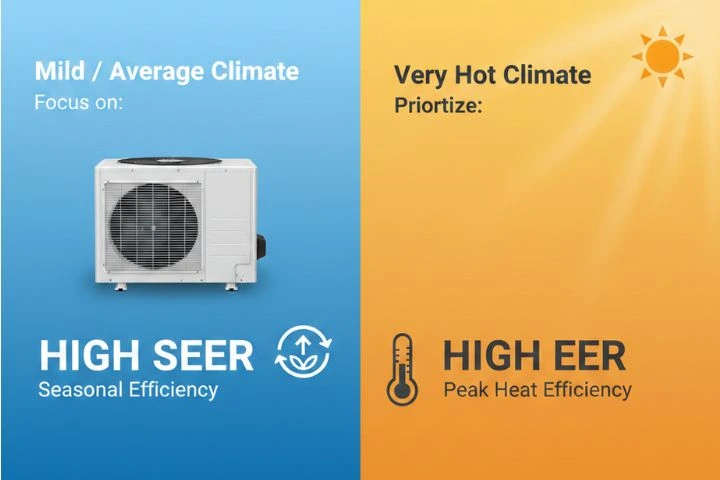
- Mild climates → focus on SEER
- Hot climates → prioritize EER
This explains EER and SEER in different climates.
SEER vs CEER Air Conditioner
You might also see SEER vs CEER air conditioner.
CEER stands for Combined Energy Efficiency Ratio.
It’s mostly used for:
- Window ACs
- Portable units
CEER includes standby power usage, making it slightly more realistic than EER.
For central or ductless systems, SEER and EER are more important.
How SEER Impacts Electricity Bills
This is where it gets exciting.
Example savings
- Old unit: 10 SEER
- New unit: 18 SEER
That’s nearly 45% less energy usage.
So yes, how SEER impacts electricity bills is huge.
Cost savings with high SEER rating
Higher SEER systems:
- Use less power
- Run quieter
- Cool faster
- Reduce monthly bills
Many homeowners save $300 to $800 per year depending on usage.
High SEER vs Low SEER Units
High SEER units
Pros:
- Lower bills
- Quieter
- Longer lifespan
- Better comfort
Cons:
- Higher upfront cost
Low SEER units
Pros:
- Cheaper to buy
Cons:
- Higher monthly costs
- Less efficient
- More strain on system
Over time, high SEER vs low SEER units usually favors high SEER financially.
Real-World HVAC Efficiency vs Rated Performance
Here’s something many websites don’t tell you.
Your system will not always hit its rated SEER.
Why?
Because of:
- Dirty filters
- Poor ductwork
- Bad installation
- Wrong system size
This explains real-world HVAC efficiency vs rated performance.
Even the best unit performs poorly if installed incorrectly.
That’s why professional installation matters.
BTU to SEER Conversion
People often ask about BTU to SEER conversion.
BTU measures cooling capacity.
SEER measures efficiency.
You cannot directly convert BTU to SEER.
Instead:
- Choose correct BTU size for your home
- Then pick highest SEER within budget
Both matter together.
Ductless Mini-Split SEER Rating
Modern ductless mini-split SEER rating numbers are impressive.
Many reach:
- 20 SEER
- 25 SEER
- even 30+ SEER
This makes mini splits extremely energy efficient, especially for small homes or room additions.
They often beat central AC in efficiency.
HSPF vs SEER vs EER
If you have a heat pump, you’ll also see:
- SEER → cooling efficiency
- EER → peak heat efficiency
- HSPF → heating efficiency
HSPF vs SEER vs EER simply means different measurements for different modes.
HVAC Energy Guide Label Explained
Every system has a yellow sticker.
The HVAC energy guide label explained:
- Estimated yearly cost
- Efficiency rating
- Comparison with other models
Always check this before buying.
Final Thoughts: Which Should You Choose?
Quick rule:
- Average climate → 16 to 18 SEER
- Very hot areas → high EER + high SEER
- Best SEER rating for AC → highest you can afford
Remember, installation quality matters as much as the rating.
Need Help Choosing the Right System?
If you want expert guidance, United State Solutions can help.
Their HVAC professionals:
- Recommend the right size AC
- Compare SEER vs EER for your climate
- Install energy-efficient systems properly
- Help lower your energy bills
Visit United State Solutions to schedule service or get a free consultation.
A smarter AC today means lower bills for years and that’s always a win.